Department: Department of Applied Mathematics

Faculty: Faculty of Mathematics

Interuniversitary research center: Galician Center for Mathematical Research and Technology (CITMAga)

Universidad: University of Santiago de Compostela

Area: Astronomy and Astrophysics

Research group: OARMA Astronomical Observatory Ramon Maria Aller

Email: manuel.andrade@usc.es

Phone: 881813147

Address: Facultade de Matemáticas (Santiago de Compostela)

Personal web: http://www.manuelandrade.eu/

Doctor by the Universidade de Santiago de Compostela with the thesis O problema de Gyldén-Mescerskij em cenários perturbados. Métodos e aplicações. 2007. Supervised by Dr. J. A. Docobo Durántez.

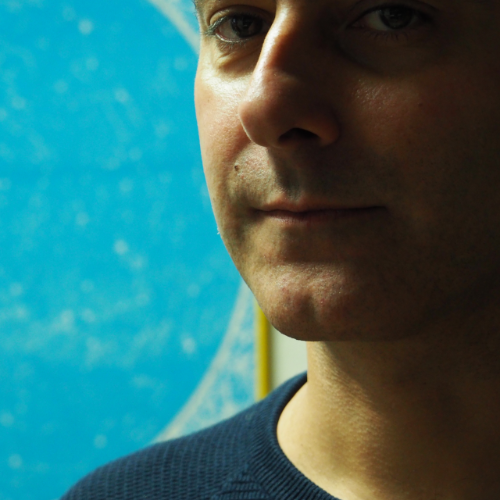
He holds a degree in Physics (specialising in Particle Physics) and a PhD in Mathematics —awarded with the extraordinary doctoral prize— from the Universidade de Santiago de Compostela (USC). Since 2003, he has been engaged in teaching and research at the Department of Applied Mathematics at USC, where he currently serves as coordinator of the Astronomy and Astrophysics Section. He is a member of the IAU and SEA, an affiliated researcher at CITMAga, and a reviewer for several of the most prestigious Astronomy journals indexed in the JCR. His research activity, reflected in numerous scientific publications and contributions to international conferences, focuses on Astrometry and Celestial Mechanics. In the field of observational astronomy, he has been responsible for observation campaigns and image reduction in speckle-interferometry projects on binary stars conducted by the research group of the Astronomy and Astrophysics Section at USC (OARMA). On the theoretical side, he has worked on the analytical integration of Hamiltonian systems, developing a canonical multiparametric perturbation method based on Lie transformations, applicable to perturbed n-body problems. In recent years, his interests have centred on the orbital dynamics of multiple stellar and planetary systems, with particular emphasis on the robust determination of masses and orbital parameters, as well as on dynamical stability analysis. His most recent line of research —initiated after determining the atmospheric trajectory and the heliocentric orbit prior to the impact of the Traspena meteorite, the first ever recovered in Galicia— focuses on meteoroid and asteroid dynamics and on modelling potential collision trajectories with Earth. He also has a long-standing commitment to science outreach and to combating light pollution, a path he began with the creation of the Sociedade Astronómica da Estrada, of which he was a driving force and founding member.