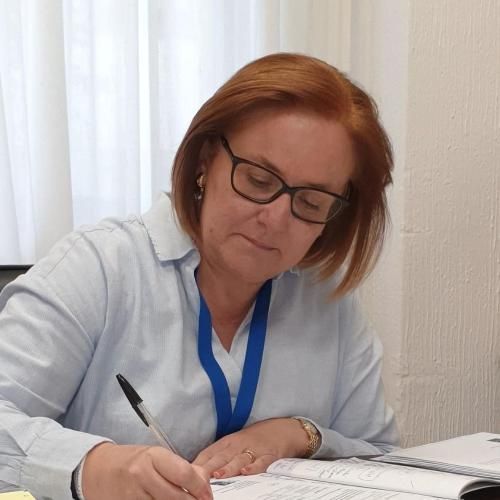
Department: Department of Physical Chemistry

Faculty: Faculty of Pharmacy

Institute: Institute of Materials (iMATUS)

Area: Physical Chemistry

Research group: BIOINTERFAR Physical Chemistry of surfaces, biointerfaces and colloidal systems of pharmaceutical interest

Email: matilde.casas@usc.es

Doctor by the Universidade de Santiago de Compostela with the thesis Acción del ácido silícico sobre monocapas de lípidos y lipidoproteínas 1990.

Prof. Matilde Casas’ first career milestone was her PhD thesis under the supervision of Prof. José Miñones Trillo, on the interaction of silicic acid with lipid-protein monolayer models of the cell membrane at the air/water interface, in order to study the molecular mechanisms involved in the ethiology of silicosis. These results allowed the team to identify the nature of the physical forces at play and the importance of the orientation of membrane dipoles, which provided a molecular explanation of lysosome membrane damage in macrophages, ultimately resulting in pulmonary fibrosis. In the years to follow, already as a Professor of Physical Chemistry, she kept on carrying out her research in the field of surface characterisation of peptides and proteins, drugs, and synthetic surfactants and polymers and their interaction with human and microorganisms cell membrane models, so as to elucidate mechanisms of action and toxicity of membrane-targeted drugs. The work she carried out through these studies, published and presented in international congresses, helped building a solid background for the use of Langmuir monolayers and Brewster Angle Microscopy (BAM) as techniques to study aggregation and lamellar phases, contributed to establish criteria based on physicochemical evidence for the choice of drug delivery systems, and shed new light on the importance of the physics and chemistry of membrane lipids in disease and pharmacological therapy. At the same time, for most of this period as well as now, she fulfilled management roles, today being Secretary of the Faculty of Pharmacy. In 2012 she moved to Prof. Isabel Sández Macho’s group, where she had the chance to expand her research scope to the characterisation and optimisation of nanostructured drug delivery systems through polymer and surfactant films at the air/water interface, which allow to imitate and analyse their aggregation behaviour in bulk solution, as it is understood to happen in the organism upon drug administration. In the last decade, she participated in substantial work on biocompatible, multistimuli-responsive amphiphilic block copolymers (poloxamers, poloxamines) with micelle-forming abilities, studying the behaviour of amphiphilic copolymer chains of different species in monolayer films under different pH and temperature conditions, as well as in the presence of solutes used as pharmaceutical excipients. Head of the research group since 2020, her team’s focus lies on biointerfaces applied to the localised drug delivery, translated into molecular and thermodynamic studies of aggregation and guest/host and host/membrane interactions, with the intention of exploring, in the next few years, how interface physical chemistry can improve drug administration and action in routes with poor bioavailability, such as the eye or other organs and tissues heavily protected by natural barriers.